
Key highlights
- Hyperscale data centers are purpose-built facilities designed to support cloud, AI infrastructure, and enterprise workloads at scale — differing from traditional facilities in capacity, efficiency, and the need for rapid, repeatable expansion.
- Modular construction compresses hyperscale delivery schedules by fabricating systems offsite in parallel with onsite work, reducing labor, improving quality control, and limiting onsite risk.
- Hyperscale data centers will increasingly rely on modular construction, disciplined end‑to‑end execution, and real‑time governance to deliver capacity faster and scale efficiently as AI‑driven demand accelerates.
Hyperscale data centers power major digital platforms for streaming, social media, AI model training, and cloud services. Delivering capacity at this scale takes disciplined engineering, clear decision-making, and tight execution.
Speed-to-market, reliability, and sustainability are the driving factors for success. But, delivering data centers on a fast-paced schedule that meet highly-sophisticated needs require design, engineering, and delivery innovations.
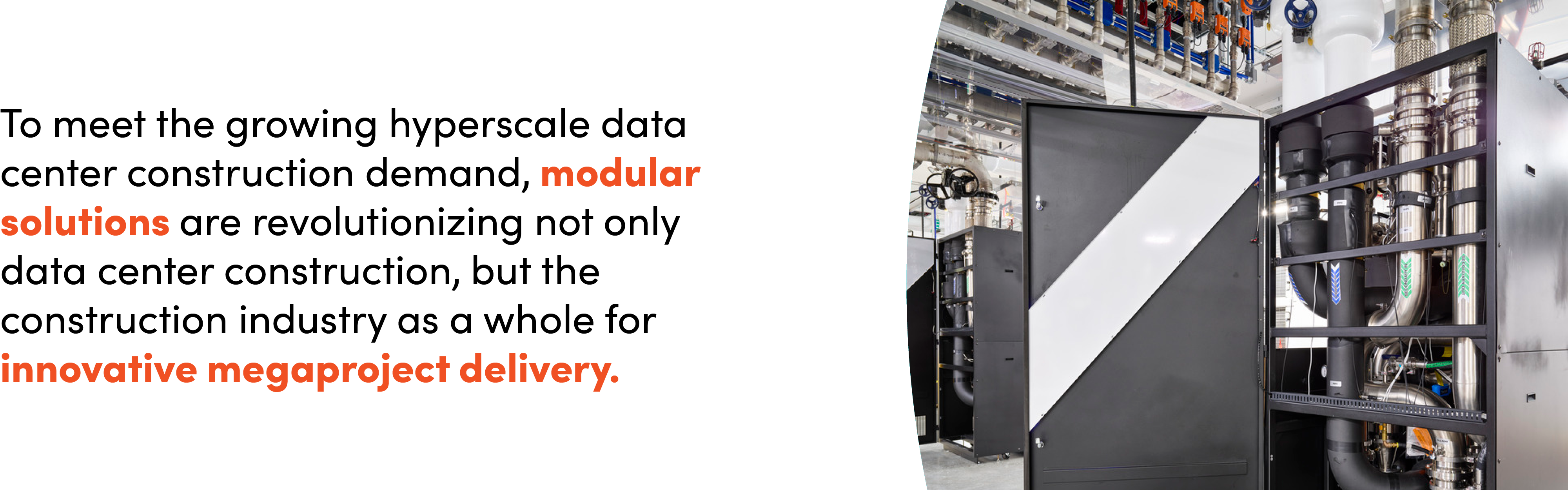
To meet the growing hyperscale data center construction demand, modular solutions are revolutionizing not only data center construction, but the construction industry as a whole for innovative megaproject delivery.
What makes hyperscale data centers different from traditional facilities?
Hyperscale facilities are purpose-built to host tens of thousands of servers and network devices with highly efficient power and cooling. They prioritize rapid expansion, high availability, and consistent performance across very large compute and storage footprints.
These data centers support cloud-first strategies and AI clusters, content delivery, edge aggregation, and enterprise workloads — with reliability affecting end-user experience. Efficiency influences total cost of ownership and environmental performance, and compared to traditional enterprise sites, hyperscale data center construction operates at a much larger scale and deploys capacity in repeatable blocks.
Standardized reference designs promote speed and uniformity across regions, while modular data centers and prefabricated blocks streamline lifecycle management and align with evolving AI infrastructure.
How are hyperscale data centers built?
Successful data center construction follows a clear, phase-driven process from site selection to handover, including site selection, design development, permitting and utilities, procurement and prefabrication, construction and fit-out, testing, and commissioning.
Throughout the process, and especially during the front-end design, a traditional approach to construction isn't going to deliver on time, on budget, and with the ability to meet unique sites' needs. A modular approach enables repeatable designs to improve, accelerate, and right-size design and construction to support the data center needs within a constrained timeline.
West Texas Data Center Project
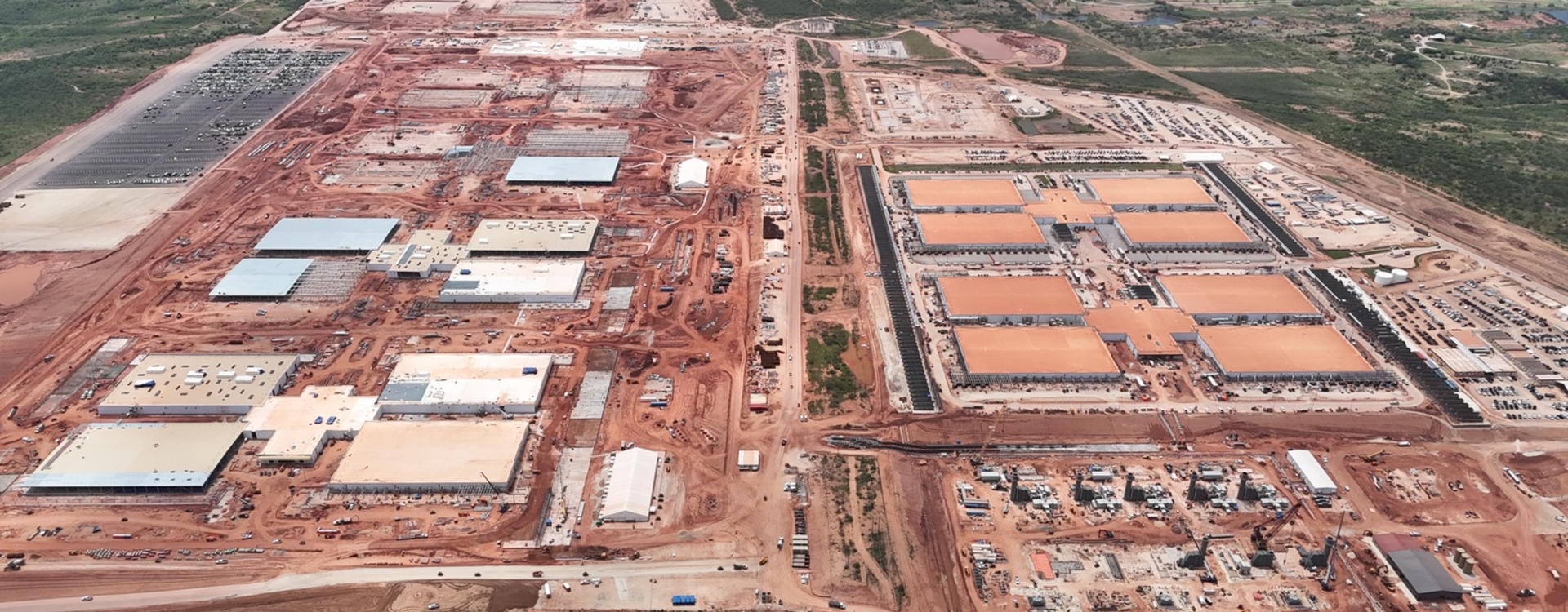
As the multi-trade prime partner on a data center project in West Texas, our project team's early engagement and willingness to execute ultimately led to better outcomes for the phased delivery. The first building achieved initial data hall turnovers in 11 months, with all data halls delivered in under 18 months.
Takeaway: Phased delivery brings the first hall online while subsequent halls and power capacity progress in parallel, aligning capital with demand.
Northern Virginia Data Center Project
Our team is engaged in 2 data center projects, including performing the design-assist role for a 20-megawatt, 182,782-square-foot data center in Sterling, VA. With this project, our team is working to integrate the HVAC, plumbing, and fire protection systems for this five-story facility, overcoming various challenges such as specialized standpipe requirements and a compact fire pump layout.
Meanwhile, we're performing the HVAC, plumbing, and fire protection scopes for a 48-megawatt, 385,000-square-foot data center in Ashburn, VA, leveraging prefabricated skids, multi‑trade racks, and fabrication to streamline delivery.
Takeaway: Integrated strategies, like prefabrication, modular solutions, and self-performance of work, kept an ambitious schedule on track.
Oregon Data Center Project
As the design-build partner for a confidential data center client in Hillsboro, Oregon, our team engineered and delivered proprietary liquid-cooled rack designs to support two 6-megawatt data vaults.
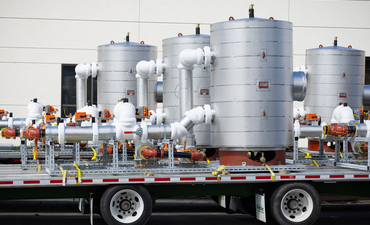
To accelerate the construction schedule, modular secondary pipe rack assemblies were designed for repeatable fabrication and installation. Production was distributed across five shops nationwide, allowing the project team to maintain certainty of outcome.
Takeaway: Proprietary liquid‑cooled rack systems and fabrication ensure fast, predictable construction of high‑capacity data vaults.
As these examples show, data center construction schedules hinge on permitting and power, with design, procurement, construction, and commissioning often overlapping.
On the MEP side, late changes or delayed involvement with mechanical systems, power distribution, electrical, and building automation can have a ripple effect on the delivery timeline, which is why bringing an MEP partner in early is one of the most effective ways to protect the construction schedule.
Future trends: looking to modular construction
Hyperscale data center construction demands modularization, speed, and precision. The best outcomes come from clear site and utility strategies, disciplined execution from design through commissioning, and expanded use of modular data centers to compress schedules.
With solid governance and real-time visibility, teams deliver capacity faster and operate more efficiently. As demand grows and AI infrastructure evolves, these fundamentals will help data center construction programs scale across regions with confidence in both cost and performance.
Frequently asked questions about hyperscale data center construction

Communication Specialist
As a Communication Specialist, Caroline Stratos supports the planning, creation, and day-to-day management of Southland's external content assets. From drafting and posting to social media channels, assisting with website content development and the implementation of SEO strategies, and supporting the execution of marketing and partnership campaigns, Caroline aims to strengthen Southland's visibility across digital channels and highlight the company's brand and projects.